Looking for an affordable sewing machine for home use, clothing alterations, and everyday stitching? The SINGER Tailor Mate Straight Stitch Sewing Machine is an interesting option for beginners and home users who want electric stitching without investing in an expensive automatic machine.
Sewing at home can save money and make everyday clothing repairs much easier. Whether you want to shorten trousers, repair a torn seam, stitch a simple kurti, or make household items, having a dependable sewing machine can be useful.
However, choosing the right machine involves more than looking at its price. Stitch quality, fabric compatibility, ease of threading, motor performance, and after-sales support all deserve attention.
The SINGER Tailor Mate Sewing Machine focuses on basic straight stitching. Its features include a foot pedal, LED sewing light, removable extension table, free-arm design, and three stitch-length settings.
But can this lightweight machine handle regular household sewing? Is it beginner-friendly? And what should you know about its limitations before buying?
This detailed SINGER Tailor Mate review examines its specifications, everyday usability, available customer feedback, advantages, disadvantages, and value for money.
SINGER Tailor Mate Sewing Machine Overview
The SINGER Tailor Mate is a compact electric sewing machine intended primarily for basic household stitching and alterations.
Unlike traditional black manual sewing machines, this model uses an electric motor and offers foot-pedal operation.
Its main appeal is simplicity. Instead of offering dozens of decorative stitches or complicated computerized controls, it concentrates on one essential function: straight stitching.
For someone who mainly wants to repair garments or complete simple sewing projects, that straightforward approach can be attractive.
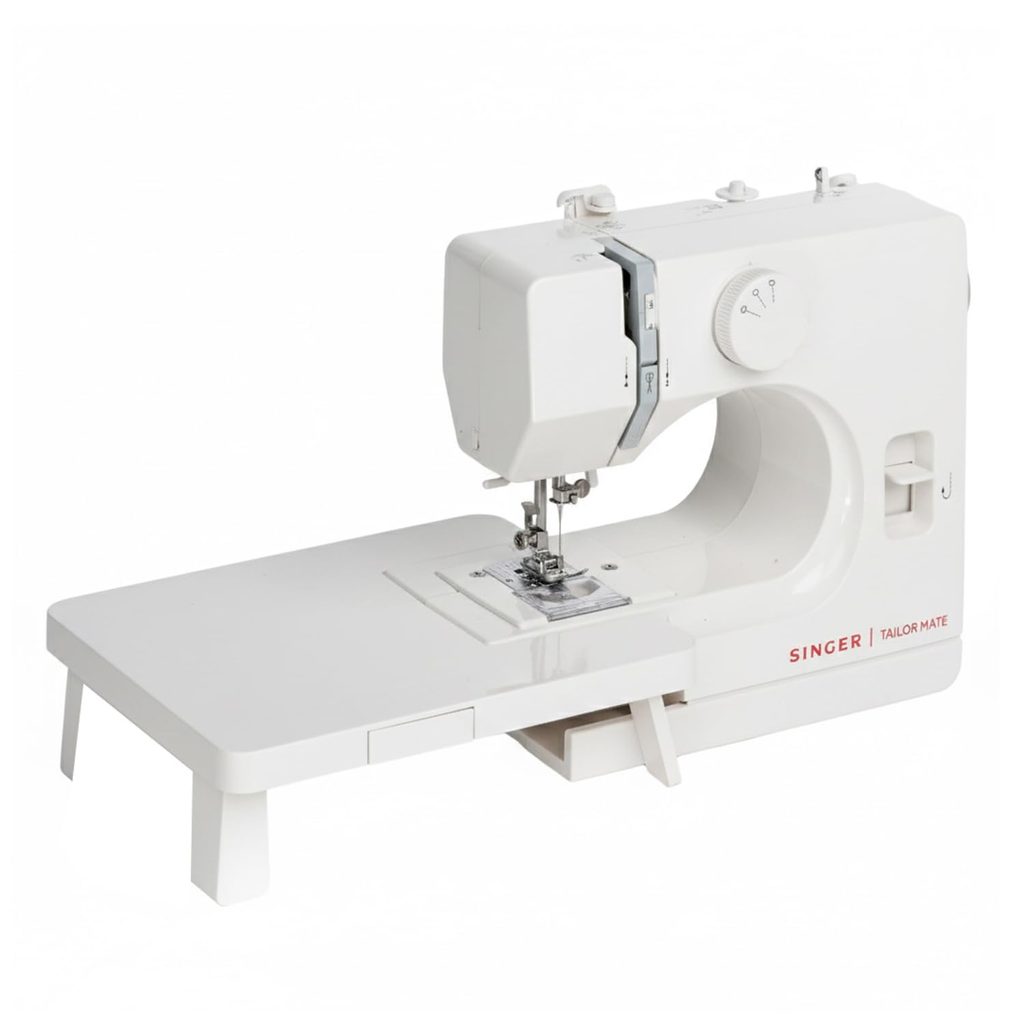
Check the SINGER Tailor Mate Sewing Machine on Amazon India.
Key Specifications
- Brand: SINGER
- Model: Tailor Mate
- Product ASIN: B0HBW3RKKC
- Machine type: Electric sewing machine
- Stitch type: Straight stitch
- Built-in stitches: 1
- Stitch-length options: 3
- Listed sewing speed: Up to 425 stitches per minute
- Lighting: Built-in LED sewing light
- Operation: Foot pedal and speed controls
- Free-arm design: Yes
- Extension table: Included
- Reverse stitching: Supported
- Thread tension adjustment: Yes
- Built-in needle threader: No
- Buttonhole functions: None
- Body material: Plastic
- Power requirement: 220–240V AC, 50Hz
- Listed power consumption: 12W
- Warranty: 1-year domestic warranty against manufacturing defects
These specifications make it clear that the Tailor Mate is a basic home sewing machine, rather than a fully featured tailoring or embroidery machine.
Its biggest advantage is the combination of electric operation and practical accessories. Its biggest limitation is that it offers only straight stitching.
Key Features of the SINGER Tailor Mate Sewing Machine
1. Straight Stitching for Everyday Sewing
The most important feature of the SINGER Tailor Mate is its straight-stitch mechanism.
Straight stitching is commonly used for joining fabric pieces, repairing torn seams, hemming clothes, and completing simple sewing projects.
For example, if your trousers are slightly too long, a straight stitch can help create a clean hem.
Similarly, if a shirt seam opens after repeated washing, you can use the machine to stitch it back together.
However, this machine does not provide built-in zigzag stitching, decorative embroidery patterns, or automatic buttonhole stitching.
That means buyers interested in fashionable embroidery or advanced garment finishing should consider a more versatile model.
For regular household repairs, though, straight stitching remains one of the most useful functions.
2. Three Stitch-Length Options
Different sewing projects may require different stitch lengths.
The Tailor Mate provides three stitch-length settings, giving users some flexibility when working with fabrics.
Shorter stitches are generally useful when a tighter seam is needed, while longer stitches may suit certain lightweight fabrics or temporary stitching.
Having adjustable stitch length can make the machine more practical than models with one completely fixed setting.
However, three preset options are less flexible than the continuously adjustable stitch-length controls found on some advanced sewing machines.
Beginners should experiment with each setting on scrap fabric before starting an important project.
3. Foot Pedal for Better Sewing Control
The included foot pedal is an important convenience feature.
Instead of operating a traditional handwheel continuously, users can control machine operation electrically.
This leaves both hands available to position and guide the fabric.
That can be particularly useful when sewing longer seams or making minor clothing alterations.
The machine also lists two-speed control functionality.
However, beginners should practise controlling the machine before sewing finished garments.
A steady sewing pace and proper fabric guidance usually produce better results than simply working at maximum speed.
4. Built-In LED Sewing Light
Good lighting makes sewing easier, especially when dealing with dark fabrics or narrow seams.
The SINGER Tailor Mate includes an LED light positioned near the sewing area.
This helps illuminate the needle and fabric while working.
The light can be particularly helpful when sewing in rooms with limited natural lighting.
However, a built-in LED should not replace proper room lighting, especially for detailed sewing work.
5. Free-Arm Design for Sleeves and Trouser Legs
One useful feature is the machine’s free-arm design.
When the removable sewing surface is taken away, the free arm makes it easier to handle tubular fabric sections.
This can simplify tasks such as:
- Hemming trouser legs
- Repairing shirt sleeves
- Stitching children’s clothing
- Altering narrow garment openings
- Working around cuffs
Without a free arm, these projects may require more fabric repositioning.
For regular home alterations, this is a genuinely practical feature.
6. Extension Table for Additional Support
The included extension table provides extra support around the sewing area.
When working with larger pieces of fabric, additional surface space can help keep material more stable.
This may be useful when stitching pillow covers, simple curtains, or other household fabrics.
However, the extension table does not turn the Tailor Mate into an industrial machine.
Large or heavy projects may still require a larger, more powerful sewing setup.
7. Reverse Stitching and Thread Tension Adjustment
Reverse stitching is useful for reinforcing the beginning and end of a seam.
Instead of leaving the stitches unsecured, users can stitch backward over a short section to help strengthen the seam.
Thread tension adjustment is another useful feature.
Correct tension helps the upper and lower threads form balanced stitches.
If tension is incorrect, users may experience loose loops, puckering, or uneven stitching.
These controls add practical value, although beginners may need some practice to use them correctly.
Stitching Performance: How Well Does the SINGER Tailor Mate Work?
Stitching performance is the most important consideration when buying a sewing machine.
The Tailor Mate has a listed sewing speed of approximately 425 stitches per minute.
This is suitable on paper for straightforward domestic sewing, although maximum speed alone does not determine stitch quality.
Fabric thickness, needle condition, threading accuracy, tension settings, and user technique also affect the final result.
Want to see the current price and available offers? Check the SINGER Tailor Mate Sewing Machine on Amazon India.
Performance on Cotton Fabric
Cotton is generally one of the easiest materials for beginners to sew.
For basic cotton garments, the Tailor Mate’s straight-stitch mechanism is appropriately suited to projects such as simple seams, repairs, and hems.
Possible uses include stitching cotton pillow covers, repairing shirts, and making simple fabric accessories.
Users should select an appropriate needle and thread, then test the stitch length before beginning.
Although the machine is designed for these basic tasks, consistent results cannot be guaranteed without hands-on testing.
Performance on Polyester and Blended Fabrics
Polyester and cotton-blend fabrics are common in everyday clothing.
The Tailor Mate may be suitable for simple seams on stable, lightweight blends.
However, some synthetic fabrics can be slippery or difficult to feed evenly.
When sewing these materials, it helps to guide the fabric gently and avoid pulling it through the machine.
Testing a small fabric sample first can reveal whether the needle, thread, and tension settings are appropriate.
Performance on Silk and Delicate Fabrics
Silk, satin, and other delicate fabrics require extra care.
These materials can slip, gather, or become damaged if the wrong needle or tension is used.
A fine, appropriate needle and careful preparation may help, but the Tailor Mate is not specifically designed for advanced delicate-fabric work.
Beginners planning expensive silk garments should practise extensively before attempting finished projects.
For frequent delicate sewing, a machine offering finer adjustments may be a better choice.
Can It Stitch Denim and Thick Fabrics?
This is an important question for buyers who want to repair jeans.
The Tailor Mate may manage some thin denim or individual lightweight fabric layers, but its ability to handle thick denim seams and multiple heavy layers has not been independently verified.
The machine should not be treated as a heavy-duty denim sewing machine.
Jeans hems often contain several thick layers, especially around folded side seams.
Forcing fabric through a lightweight machine can cause needle breakage, skipped stitches, or mechanical strain.
If denim alterations are your main requirement, consider a stronger machine with clearly documented thick-fabric capability.
Performance on Stretchable Fabrics
Stretchy fabrics such as jersey and certain knitted materials present another limitation.
Straight stitches do not stretch as readily as zigzag or specialist stretch stitches.
As a result, seams may break when the garment stretches during use.
Although certain techniques can make straight stitching work for limited applications, the Tailor Mate is not the most versatile choice for regular knitwear sewing.
Buyers planning leggings, T-shirts, or other stretchy garments should consider a machine with suitable stretch-stitch functions.
Ease of Use: Is the SINGER Tailor Mate Good for Beginners?
The SINGER Tailor Mate is designed around relatively simple controls.
That makes it worth considering for beginners who want to learn basic machine sewing.
However, beginner-friendly does not mean completely effortless.
New users still need to understand needle threading, bobbin preparation, thread tension, and fabric handling.
Setting Up the Machine
Before using the Tailor Mate, users should inspect the machine and accessories.
Check that the foot pedal, power connection, extension table, and other supplied components are present and undamaged.
Then follow the official operating instructions for upper threading and bobbin installation.
Incorrect threading is one of the most common causes of poor stitches on domestic sewing machines.
New users should avoid assuming that an unfamiliar threading route is identical to that of another machine.
After setup, practising on spare cotton fabric is a sensible first step.
Learning Basic Sewing Techniques
A beginner can start with simple exercises such as sewing straight lines on scrap cloth.
Once comfortable, they can practise joining two pieces of fabric and securing a seam with reverse stitching.
The next step could be making a small pouch or completing a basic trouser hem.
These activities help develop control over sewing speed and fabric direction.
The machine’s uncomplicated stitch selection reduces the number of settings a new user needs to learn.
However, it does not have a built-in automatic needle threader, so threading the needle must be handled manually.
Portability and Storage
The Tailor Mate has a lightweight plastic body, making it easier to move than many traditional metal sewing machines.
This can be useful for people living in smaller homes or apartments.
You can place it on a stable table when required and put it away after finishing.
However, lightweight construction has a trade-off.
The machine may need careful positioning to remain stable, particularly when handling larger pieces of fabric.
A firm, level sewing surface is recommended.
Pros and Cons of the SINGER Tailor Mate Sewing Machine
Pros
- Beginner-friendly concept: Basic controls make it approachable for simple sewing.
- Electric operation: Removes the need for continuous manual operation.
- Foot pedal: Helps keep both hands available for guiding fabric.
- Free-arm design: Useful for sleeves, cuffs, and trouser alterations.
- LED light: Improves visibility around the needle.
- Extension table: Offers additional support for fabric.
- Three stitch lengths: Adds flexibility for everyday projects.
- Reverse stitching: Helps reinforce seams.
- Lightweight construction: Convenient for storage and occasional use.
- One-year warranty: Provides limited protection against covered manufacturing defects.
Cons
- Straight stitch only: No zigzag or decorative stitches.
- No automatic buttonhole function: Limits garment-making versatility.
- No built-in needle threader: Manual threading may frustrate some beginners.
- Limited heavy-fabric capability: Thick denim and multiple fabric layers are not proven strengths.
- Plastic construction: May be less suitable for demanding, continuous use.
- Limited stitch adjustment: Three stitch-length options may restrict advanced work.
- Not suitable for embroidery: Buyers need another machine for decorative stitching.
- Some customer complaints: Reports include defective units, damaged packaging, and difficulties obtaining repair assistance.
Overall, its strengths are convenience and basic functionality rather than advanced sewing versatility.
SINGER Tailor Mate Customer Reviews: What Are Buyers Saying?
Customer feedback is especially valuable when evaluating an affordable sewing machine.
The Amazon listing for ASIN B0HBW3RKKC has appeared with an overall rating of approximately 4.3 out of 5 stars, with more than 11,000 ratings.
However, ratings can change, and Amazon sometimes groups reviews across product variations.
The complete live Amazon review history was not independently accessible for this assessment. The observations below therefore reflect identifiable customer comments available through a third-party retail mirror, rather than a comprehensive review of every Amazon buyer.
Positive Customer Feedback
Some customers describe the Tailor Mate as convenient for basic home stitching.
Positive observations include relatively simple setup, lightweight construction, and usefulness for everyday garment repairs.
One customer specifically highlighted the convenience of the LED light and free arm when handling sleeves.
Another considered the machine suitable for basic home sewing and learning.
These comments are consistent with the machine’s intended purpose.
For buyers who only need occasional straight stitching, a compact electric machine can be more convenient than a traditional manual alternative.
Common Complaints and Negative Feedback
Not all customer experiences have been positive.
Some available comments describe machines arriving defective or failing to operate correctly.
Other complaints involve damaged packaging, missing components, or products that appeared previously handled.
One particularly concerning customer account describes difficulty obtaining local repair assistance after the machine stopped working.
These reports do not establish how frequently such problems occur.
Nevertheless, they highlight why buyers should inspect the machine immediately after delivery and confirm service arrangements.
What Customer Feedback Really Suggests
The available feedback paints a mixed but understandable picture.
Some users appreciate the Tailor Mate for straightforward, occasional stitching.
Others have experienced problems involving delivery condition, machine operation, or servicing.
There is not enough verified evidence to claim that every machine delivers consistently excellent stitching or long-term durability.
A sensible approach is to focus on the seller’s reliability, return conditions, and warranty support before purchasing.
Who Should Buy the SINGER Tailor Mate?
Beginners Learning Home Sewing
For someone learning to sew straight seams, the Tailor Mate is worth considering.
Its limited stitch selection reduces complexity, while the foot pedal and LED light provide useful conveniences.
It is especially appropriate for learners who want to begin with cotton fabric and straightforward sewing projects.
Home Users Making Occasional Alterations
This is probably the machine’s strongest use case.
If you regularly need to shorten trousers, repair open seams, or stitch simple household fabrics, the Tailor Mate offers the main functions required.
Its free arm is a useful addition for clothing alterations.
Students and Sewing Hobbyists
Students practising fundamental sewing techniques may appreciate a machine that is compact and simple to operate.
It can be used to learn threading, seam allowances, stitch-length selection, and basic fabric handling.
However, students taking a comprehensive fashion-design course may eventually require more stitch types.
Who Should Avoid This Machine?
The Tailor Mate is less suitable for people who regularly sew thick denim, leather, heavy canvas, or multiple bulky layers.
It is also not ideal for buyers who need automatic buttonholes, decorative embroidery, zigzag finishing, or specialised stretch stitches.
Someone planning to operate a full-time tailoring business should look for a machine built for longer sewing sessions and more demanding fabric workloads.
Is the SINGER Tailor Mate Worth Its Price?
Value for money depends on your sewing requirements.
The Tailor Mate has appeared in Indian online listings around the ₹4,500–₹5,000 range, although its current price and availability should be checked directly.
At this general price level, the combination of a foot pedal, LED light, free arm, and extension table can be appealing.
However, a low purchase price is not automatically good value.
A machine that lacks the stitches required for your projects can become a costly compromise.
For someone who only needs straight stitching, the Tailor Mate may offer a practical starting point.
For someone planning varied dressmaking projects, spending more on a machine with zigzag and buttonhole functions may deliver better long-term value.
Want to see the current price and available offers? Check the SINGER Tailor Mate Sewing Machine on Amazon India.
Tips for Getting Better Results with the SINGER Tailor Mate
A sewing machine works best when it is used and maintained correctly.
Start with clean cotton fabric while learning its controls.
Always choose a suitable needle for the fabric and thread you are using.
If stitches become uneven, check the threading route, bobbin placement, and tension before assuming the machine is defective.
Avoid pulling fabric forcefully while sewing. The feed mechanism should move the material through the machine.
Replace bent or damaged needles promptly.
Keep lint away from the bobbin area and follow the manufacturer’s cleaning instructions.
Finally, test unfamiliar fabrics on scraps before working on finished garments.
These habits can reduce avoidable sewing problems and help users develop more consistent results.
Frequently Asked Questions About the SINGER Tailor Mate Sewing Machine
1. Is the SINGER Tailor Mate good for beginners?
Yes, it is worth considering for beginners interested in basic straight stitching. Its electric operation, foot pedal, and limited controls make it relatively approachable, although proper threading and setup still require practice.
2. Can the SINGER Tailor Mate stitch jeans?
It may handle some lightweight denim, but thick jeans hems and multiple heavy layers are not verified strengths. Buyers who frequently sew denim should consider a more powerful machine.
3. Does it support zigzag stitching?
No. The Tailor Mate is a straight-stitch sewing machine and does not offer built-in zigzag stitching.
4. Can I use this machine for blouse and kurti stitching?
It may be used for straightforward seams and basic garment construction. However, projects requiring decorative stitching, zigzag finishing, or specialist fabric handling may need a more versatile machine.
5. Does the SINGER Tailor Mate come with a foot pedal?
Yes. The listed product includes a foot pedal for electric sewing operation.
6. Does it have an automatic needle threader?
No. This model does not list a built-in automatic needle threader. Users should expect to thread the needle manually.
7. Can it stitch curtains and pillow covers?
Yes, simple projects involving appropriately lightweight household fabrics are among its intended uses. Very thick curtain materials or bulky layered sections may be difficult.
8. Does it have an extension table?
Yes. The Tailor Mate includes an extension table that provides additional support around the sewing area.
9. What warranty does the machine offer?
The listed warranty is one year for covered manufacturing defects. Buyers should confirm the applicable terms, seller details, and local service arrangements before purchasing.
10. Is it suitable for professional tailoring?
It is better suited to basic home sewing and occasional alterations. Professional users requiring varied stitches, continuous operation, or dependable heavy-fabric performance should consider a more capable machine.
Final Verdict: Should You Buy the SINGER Tailor Mate Sewing Machine in 2026?
The SINGER Tailor Mate Straight Stitch Sewing Machine is a practical option to consider if your sewing needs are simple.
Its main attractions are electric operation, straightforward controls, a useful free arm, LED lighting, an extension table, and three stitch-length settings.
For occasional home sewing, basic repairs, and beginner practice, those features cover many everyday requirements.
However, the machine has clear limitations.
It cannot replace a multi-stitch sewing machine for decorative work, stretch fabrics, or projects requiring zigzag and buttonhole stitching.
Its suitability for thick materials and demanding continuous use is also uncertain.
Customer feedback includes encouraging comments about ease of use, alongside concerning reports about defective deliveries and repair difficulties.
Our verdict: The SINGER Tailor Mate is worth considering as an affordable straight-stitch machine for beginners and occasional home users, provided you understand its limitations and verify warranty support.
If you want to repair everyday clothes and learn fundamental sewing skills without paying for advanced features, it could be a reasonable choice.
If you expect to sew many different fabrics or make complete garments regularly, a more versatile sewing machine may be the wiser investment.
Before ordering, compare the current price, confirm which accessories are included, and read the latest customer reviews for the exact product variation.
Ready to explore the machine? View the SINGER Tailor Mate Sewing Machine, latest price, and customer reviews on Amazon.