Buying a sewing machine for home use sounds simple until you start comparing different models. Some machines are affordable but offer only straight stitching. Others come with advanced features that beginners may find confusing. Finding the right balance between ease of use, useful functions, and long-term value is important.
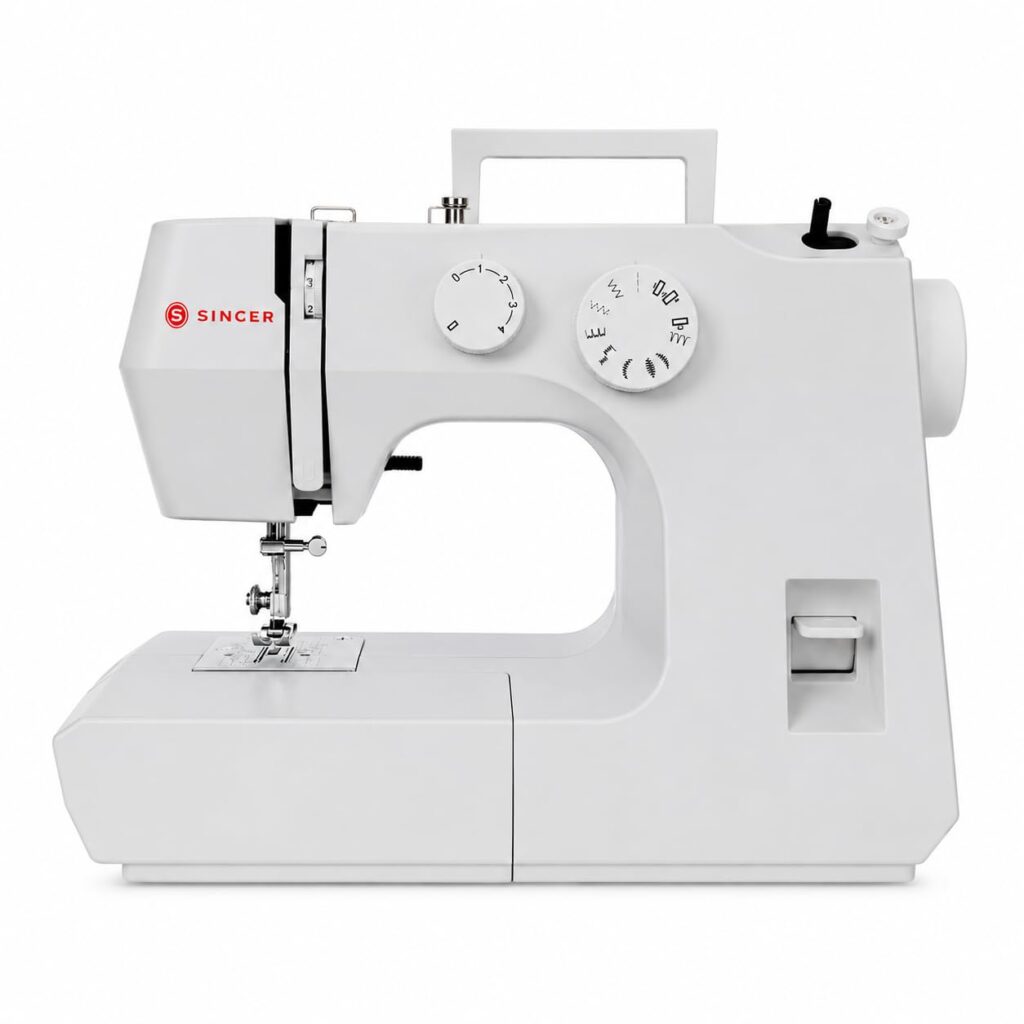
The SINGER 1410 Automatic Zig Zag Sewing Machine aims to provide that balance. With 10 built-in stitches, 22 stitch functions, a 60W motor, free-arm sewing, and a metal internal frame, it is designed for common household sewing projects.
Whether you want to repair clothes, stitch kurtis, alter trousers, create cushion covers, or learn tailoring, this machine offers several features worth considering.
But is the SINGER 1410 actually good for beginners? Can it handle denim and other thick fabrics? And does its performance justify its price in India?
In this detailed SINGER 1410 sewing machine review, we examine its specifications, practical stitching capabilities, customer feedback, advantages, limitations, and overall value to help you make an informed buying decision.
SINGER 1410 Sewing Machine Overview
The SINGER 1410 is an electric zig-zag sewing machine designed primarily for domestic sewing, garment alterations, and creative stitching.
It offers more versatility than a traditional straight-stitch machine without requiring the complicated controls found on some computerized models.
Main Specifications
- Brand: SINGER
- Model: 1410
- Machine type: Electric zig-zag sewing machine
- Built-in stitches: 10
- Stitch functions: 22
- Motor power: 60W
- Advertised sewing speed: Approximately 800 stitches per minute
- Stitch width: Up to 5mm
- Stitch selection: Mechanical dial
- Buttonhole function: Four-step buttonhole
- Bobbin system: Front-loading
- Frame: Heavy-duty internal metal frame
- Gear mechanism: Metal gears
- Free-arm sewing: Yes
- Reverse stitching: Yes
- Needle lighting: LED
- Machine dimensions: Approximately 42 × 22 × 35 cm
- Listed weight: Approximately 4kg
- Warranty: Two years, subject to applicable terms
- Manufacturer: Singer India Limited
The SINGER 1410 focuses on useful everyday functions rather than offering dozens of decorative stitches.
Its combination of straight stitching, zig-zag capability, buttonholes, and a free arm makes it suitable for a variety of ordinary sewing projects.
However, buyers should remember that its metal frame and 60W motor do not automatically make it an industrial heavy-duty machine.
View the SINGER 1410 Sewing Machine on Amazon India.
Key Features of the SINGER 1410 Sewing Machine
1. Ten Built-In Stitches and 22 Stitch Functions
One of the most useful features of the SINGER 1410 is its selection of 10 built-in stitches and 22 stitch functions.
These options support different tasks, including everyday garment stitching, selected decorative work, blind hemming, and buttonholes.
Straight stitching is useful for joining fabric pieces, repairing seams, and constructing garments.
Zig-zag stitching provides flexibility for certain fabric-edge finishes, appliqué, and sewing techniques that require a stitch wider than a straight line.
Blind hemming can be useful when a less noticeable hem is desired, although achieving neat results requires practice.
The difference between built-in stitches and stitch functions is worth understanding. The machine does not offer 22 completely independent decorative patterns. Its 10 built-in stitches can be used for multiple sewing applications.
For beginners and occasional home users, this selection should cover many common requirements without making the machine unnecessarily complicated.
2. Powerful 60W Motor
The SINGER 1410 is equipped with a 60-watt motor intended for domestic sewing.
This motor provides power for ordinary stitching projects involving suitable clothing and household fabrics.
For tasks such as sewing cotton garments, joining polyester blends, and completing routine alterations, the motor specification is consistent with the machine’s intended use.
However, wattage alone cannot determine actual sewing strength.
Needle type, fabric thickness, thread quality, feed performance, and seam construction all influence how smoothly a sewing machine operates.
Users planning to work regularly with thick denim, upholstery, or heavy canvas should not assume that the 60W motor guarantees reliable multi-layer stitching.
3. Heavy-Duty Metal Frame and Metal Gears
The SINGER 1410 includes an internal metal frame and metal gear mechanism.
This construction is intended to provide stability and support consistent sewing during everyday operation.
A sturdy frame can be beneficial when sewing longer seams because excessive machine movement may affect comfort and accuracy.
Metal gears are another positive construction feature, although their presence alone does not prove that the machine will require less maintenance or last longer than every competing model.
Regular cleaning, correct operation, and appropriate fabric selection remain important.
For home users who prefer a relatively solid machine instead of an extremely lightweight portable model, the construction is worth considering.
4. Free-Arm Sewing for Sleeves and Trouser Hems
Free-arm capability is one of the SINGER 1410’s most practical features.
A free arm provides a narrower sewing surface that helps users work around tubular garment sections.
This makes tasks such as stitching sleeve cuffs, altering trouser hems, and repairing children’s clothing more convenient.
For example, shortening a pair of trousers with a flat sewing platform may require more careful handling to avoid accidentally sewing together both sides of the fabric tube.
A free arm provides easier access to such areas.
It is particularly valuable for households where frequent clothing alterations are necessary.
5. Four-Step Buttonhole Function
The SINGER 1410 supports four-step buttonhole sewing.
This feature is useful when making shirts, dresses, children’s garments, and other clothing that requires buttons.
Unlike a one-step automatic buttonhole system, the four-step mechanism requires users to complete different sections of the buttonhole in sequence.
That means it involves additional attention and practice.
Beginners should test the function on spare fabric before working on a finished garment.
Although it is not the most automated buttonhole system available, it adds useful garment-making capability.
6. Reverse Stitching and Adjustable Thread Tension
Reverse stitching helps reinforce the beginning and end of seams.
This is particularly useful when repairing garments or constructing clothing that will experience regular movement and washing.
The machine also includes thread-tension adjustment.
Correct tension is essential for balanced stitches. If the tension is unsuitable for the selected fabric and thread, stitching may appear loose, uneven, or puckered.
New users should learn the recommended starting settings before making adjustments.
7. LED Needle Light and Bobbin Winder
The built-in LED light illuminates the sewing area.
This can make it easier to see the needle position, seam allowances, and stitching lines, particularly when working with dark fabric.
The machine also includes a bobbin-winding mechanism, which simplifies preparing the lower thread.
Its front-loading bobbin system may take some practice for first-time users, but it is a familiar arrangement on many mechanical sewing machines.
View the SINGER 1410 Sewing Machine on Amazon India.
SINGER 1410 Stitching Performance: How Does It Handle Different Fabrics?
Stitching performance is arguably more important than the number of features advertised.
The SINGER 1410 has specifications suitable for normal domestic sewing, but performance will vary depending on the material, needle, thread, and settings.
The following assessment explains its likely suitability based on the machine’s functions rather than claiming independent hands-on testing.
Cotton Fabric and Everyday Clothing
Cotton is one of the most practical materials for learning sewing.
The SINGER 1410 offers the basic functions needed for cotton clothing, pillowcases, simple tote bags, and similar projects.
Straight stitching is useful for garment construction, while zig-zag stitching can help finish selected fabric edges.
Beginners can practise sewing parallel lines, joining two pieces of cotton, and making simple hems before moving to more complicated projects.
Polyester and Blended Fabrics
Cotton-polyester blends and many ordinary polyester fabrics are commonly used for shirts, uniforms, kurtis, and household textiles.
The SINGER 1410 is a reasonable candidate for these applications.
However, lightweight synthetic fabric may move or gather differently from cotton.
Using suitable needles, carefully adjusting tension, and guiding fabric without pulling it can help prevent stitching problems.
Denim and Thick Fabric
Many buyers want to know whether the SINGER 1410 can stitch jeans.
It may be suitable for selected light denim repairs or alterations when the correct denim needle and settings are used.
However, there is an important difference between stitching a flat piece of denim and crossing several thick layers near a jeans pocket or waistband.
The machine’s advertised specifications do not establish how reliably it can handle repeated heavy denim work.
For regular jeans manufacturing, thick upholstery, leather, or demanding bag-making projects, a dedicated heavy-duty machine would be a safer choice.
Stretch Fabrics and Knitted Materials
Zig-zag stitching can be useful for certain stretch-fabric seams because it allows more movement than ordinary straight stitching.
That makes the SINGER 1410 potentially useful for simple repairs involving elastic or knitted fabrics.
However, stretch materials require suitable needles and careful setup.
The machine is not a direct replacement for a dedicated overlocker, especially when making large quantities of T-shirts or other knitted garments.
Delicate Fabrics
Lightweight cotton, thin polyester, and other delicate fabrics can be more demanding than they appear.
These materials may pucker, slip, or become damaged when the wrong needle or tension is used.
Start with scrap fabric, use the correct needle, and adjust the settings carefully.
The SINGER 1410 provides useful mechanical controls, but good results still depend on technique.
Ease of Use: Is the SINGER 1410 Good for Beginners?
The SINGER 1410 is a reasonable option for beginners who want to learn basic sewing and gradually develop their skills.
Its mechanical controls are relatively straightforward compared with computerized sewing machines that offer extensive menus and settings.
Simple Stitch Selection
The machine uses a dial-based stitch-selection system.
This makes choosing between supported stitches relatively direct once the user understands the stitch markings.
Beginners should initially focus on straight stitching, zig-zag stitching, and reverse stitching.
More complicated techniques can be introduced gradually.
Complimentary Sewing Demonstration
The Amazon product listing advertises a complimentary sewing demonstration and expert guidance.
According to the listing, this guidance covers threading, stitch selection, machine operation, and basic sewing techniques.
This could be helpful for first-time buyers unfamiliar with electric machines.
However, the precise demonstration arrangement, location coverage, and availability should be confirmed with the seller or manufacturer before purchase.
Learning the Front-Loading Bobbin
The front-loading bobbin system may be unfamiliar to someone who has never operated a sewing machine.
Incorrect bobbin placement or threading can cause stitch formation problems.
Following the user manual and practising the insertion process will help.
The SINGER 1410 also does not list a built-in automatic needle threader, so users should expect to thread the needle manually.
Everyday Maintenance
Like other domestic sewing machines, the SINGER 1410 requires reasonable care.
Remove lint according to the instruction manual, change worn needles, use suitable thread, and keep the machine protected from moisture and excessive dust.
Follow the manufacturer’s instructions regarding lubrication rather than applying oil without guidance.
SINGER 1410 Pros and Cons
Advantages
- 10 built-in stitches: Useful for ordinary garment construction and repairs.
- 22 stitch functions: Offers flexibility beyond basic straight stitching.
- 60W motor: Intended for routine domestic sewing.
- Metal internal frame: Designed to provide structural stability.
- Metal gears: A useful construction feature.
- Free-arm sewing: Convenient for sleeves, cuffs, and trouser hems.
- Four-step buttonholes: Supports clothing projects involving buttons.
- Reverse stitching: Helps reinforce seams.
- LED light: Improves visibility around the needle.
- Two-year warranty: Offers manufacturer-backed coverage under applicable conditions.
Disadvantages
- Limited decorative stitch variety: Only 10 built-in stitches compared with more advanced models.
- Manual needle threading: No confirmed built-in automatic needle threader.
- Four-step buttonholes: Require more user involvement than one-step systems.
- Front-loading bobbin: May take beginners some time to learn.
- Not intended for continuous industrial sewing: Heavy-duty performance should not be assumed.
- No computerized controls: Users seeking advanced automation may find the machine basic.
SINGER 1410 Customer Reviews: What Are Buyers Saying?
Customer feedback helps reveal whether the machine’s advertised features translate into a satisfying ownership experience.
The SINGER 1410 has accumulated substantial rating activity across online marketplaces.
An October 2026 price-tracking snapshot for Amazon ASIN B0H11MQZQV reported an average equivalent to approximately 4.5 out of 5 stars across 10,279 ratings.
A separate Flipkart listing for the SINGER 1410 displayed approximately 4.3 out of 5 stars from more than 2,000 ratings.
These are encouraging figures, although marketplace ratings may sometimes combine feedback from related product variants.
Individual written Amazon reviews for the exact ASIN were not independently accessible during this assessment, so specific Amazon customer complaints cannot be reliably attributed to this listing.
Positive Feedback from Customers
One identifiable Flipkart customer review described the SINGER 1410 as a good choice for beginners and intermediate users, highlighting the usefulness of its built-in stitches for creating designs.
Another recent review praised the product’s quality and expressed satisfaction with the purchase.
These comments support the idea that some buyers appreciate the machine’s versatility and accessibility.
However, two positive comments do not establish that every buyer will experience the same stitching quality or reliability.
Common Concerns Buyers Should Investigate
The available evidence does not establish a verified pattern of repeated defects specific to this ASIN.
Nevertheless, several practical concerns deserve attention when reading the latest customer reviews.
Thread tension and stitch consistency: Look for detailed feedback describing performance after the machine has been correctly threaded and adjusted.
Bobbin handling: Check whether first-time owners found the front-loading system easy to understand.
Thick-fabric performance: Reviews showing actual denim or multi-layer stitching are more useful than general claims about motor power.
Demonstration availability: Verify whether customers in your area received the advertised sewing demonstration.
Accessories and delivery: Check recent feedback concerning package completeness and shipping condition.
These are areas to investigate rather than confirmed recurring complaints.
Should You Trust the Customer Ratings?
The overall rating figures suggest a generally positive response, but they should be interpreted carefully.
Before buying, filter reviews by the exact 1410 model, check recent written feedback, and give more weight to reviews that describe specific sewing projects.
Detailed owner experiences are usually more informative than ratings without explanations.
Want to see the latest verified-buyer experiences? Read SINGER 1410 Customer Reviews on Amazon India.
Who Should Buy the SINGER 1410 Sewing Machine?
Beginners Learning Home Sewing
The SINGER 1410 makes sense for beginners who want a machine with useful stitch options without moving immediately to computerized sewing.
Its dial controls and advertised demonstration support make it worth considering.
Homemakers Handling Regular Clothing Alterations
People who regularly shorten trousers, repair seams, adjust clothing, or stitch household fabrics may appreciate its free arm, reverse stitching, and zig-zag capability.
Hobby Sewers
The machine is suitable for people interested in simple DIY sewing projects, cushion covers, fabric accessories, and selected decorative sewing techniques.
Its stitch selection provides some creative flexibility without excessive complexity.
Home Tailoring Learners
Someone learning to stitch kurtis, blouses, children’s garments, or everyday clothing may find its features relevant.
However, garment construction also requires proper measurements, cutting, pressing, and practice.
Who Should Avoid It?
The SINGER 1410 may not be the best purchase for professional tailors who need continuous commercial operation.
Likewise, people primarily working with thick upholstery, leather, or heavy denim should consider specialised machines.
Buyers wanting automatic needle threading, one-step buttonholes, or extensive decorative stitch libraries may also prefer a more advanced model.
SINGER 1410 Price and Value for Money in India
The SINGER 1410 belongs to the mid-range domestic electric sewing machine category.
An October 14, 2026 price-tracking record showed the Amazon listing at approximately ₹11,990, compared with a listed MRP of ₹18,900.
Prices can change with promotions, sellers, location, and availability.
At around ₹12,000, the SINGER 1410 offers a reasonable combination of mechanical sewing functions, free-arm convenience, and metal-frame construction.
However, buyers should compare its actual selling price against alternative SINGER, Usha Janome, and Brother machines available at the time of purchase.
If you only need occasional straight stitching, a simpler model may save money.
If you regularly sew garments and need zig-zag stitches, buttonholes, and free-arm access, paying more for these functions may make sense.
The best value comes from purchasing a machine that matches your real sewing needs rather than choosing whichever listing advertises the biggest discount.
Frequently Asked Questions About the SINGER 1410
1. Is the SINGER 1410 suitable for beginners?
Yes. Its mechanical stitch controls, basic utility functions, and advertised complimentary demonstration make it a reasonable choice for beginners. Some practice will still be needed to master threading, tension, and fabric handling.
2. How many stitches does the SINGER 1410 have?
It has 10 built-in stitches and 22 advertised stitch functions. These allow different household sewing applications, including ordinary seams, zig-zag stitching, and selected decorative techniques.
3. Can the SINGER 1410 stitch jeans?
It may handle selected denim alterations using the correct needle and settings. However, reliable performance through multiple thick denim layers has not been established, so it should not be considered a dedicated industrial denim machine.
4. Can I stitch kurtis and blouses with this machine?
Yes. The SINGER 1410 offers functions relevant to ordinary kurti and blouse stitching. Its suitability depends on the garment design, fabric thickness, and the user’s sewing skills.
5. Does it have an automatic needle threader?
The available specifications indicate that the SINGER 1410 does not include a built-in automatic needle threader. The needle must be threaded manually.
6. What is the sewing speed of the SINGER 1410?
Marketplace specifications advertise approximately 800 stitches per minute. Actual working speed depends on machine operation and the sewing task.
7. Does the SINGER 1410 come with a warranty?
The product is advertised with a two-year warranty. Buyers should confirm registration requirements, service availability, exclusions, and applicable terms before purchasing.
8. Is the SINGER 1410 better than a straight-stitch sewing machine?
It offers greater versatility because it includes zig-zag and additional stitch functions. However, if your work involves only simple straight seams, a less expensive straight-stitch machine may be sufficient.
Final Verdict: Is the SINGER 1410 Worth Buying in 2026?
The SINGER 1410 Automatic Zig Zag Sewing Machine is a practical option for people seeking a reasonably versatile electric machine for domestic sewing.
Its 10 built-in stitches, 22 stitch functions, 60W motor, free-arm design, reverse stitching, LED light, and metal internal construction provide a useful combination of features.
It is particularly worth considering for beginners who want to learn tailoring, homemakers handling regular alterations, and hobby sewists interested in everyday clothing and fabric projects.
The machine’s limitations are equally important. It does not offer extensive computerized functions, automatic needle threading, or verified industrial-grade thick-fabric performance.
Available aggregate customer ratings are encouraging, but they do not replace checking recent written reviews for the exact model.
Overall, the SINGER 1410 is worth considering if you want a mechanical electric sewing machine with more flexibility than a straight-stitch-only model, without paying for advanced computerized features.
Before buying, confirm the current price, warranty conditions, demonstration availability, and latest customer feedback.
Ready to make your decision? Check the Latest SINGER 1410 Sewing Machine Price on Amazon India.